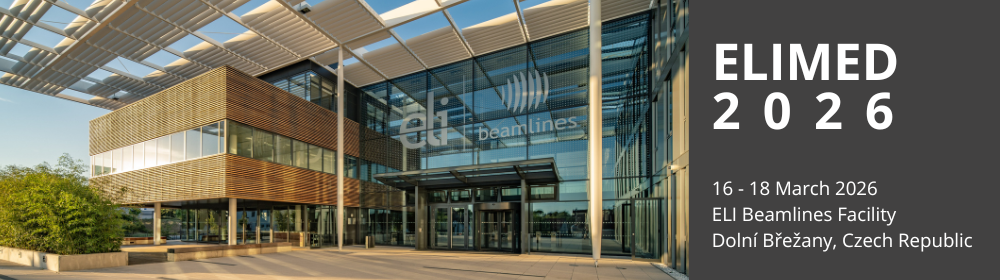
Description
Laser-driven ion acceleration is a promising compact alternative to conventional ion accelerators, with applications spanning fusion research, medical technologies, industrial processing, security, and cultural heritage studies. A key challenge is advancing laser-driven proton sources toward application-relevant performance, particularly in terms of beam energy, beam quality, and compatibility with modern high-repetition-rate–capable laser systems. In this work, we present results from an experiment conducted using a high-repetition-rate–capable Ti:sapphire petawatt laser at the ELI Beamlines facility, employing helical coil (HC) targets to enhance proton beam properties. We demonstrate tunable post-acceleration of laser-accelerated protons, achieving a maximum energy increase from 27 MeV to over 40 MeV. Efficient beam collimation was also observed, with the proton beam divergence reduced from a half-cone angle of 10° to below 0.5° at distances far from the source. We further discuss prospects for scaling to higher laser intensities on fs laser systems